
10 hr
East Jeju UNESCO Heritage Day Tour
Discover volcanic caves, coastal peaks, and traditional culture across eastern Jeju's UNESCO treasures
Reserve
Hand-picked by our editors — the best 5 UNESCO heritage tours from 12 reviewed
Verified partners for every tour, free cancellation where available, and instant confirmation on every booking.
10 hr
Discover volcanic caves, coastal peaks, and traditional culture across eastern Jeju's UNESCO treasures
Reserve
9 hr
Nine-hour guided journey through volcanic peaks, coastal villages, and UNESCO sites—ideal for newcomers
Reserve
10 hr
Discover volcanic craters, lava tunnels, and traditional culture on a full-day journey through Jeju's eastern highlights
ReservePrices from verified partners. Availability updates in real time at checkout. Free cancellation policies apply where shown.
The landmarks, rooms, and views travelers on this tour remember — all visible on a single visit.
This 600-meter-wide crater is covered in lush silver grass and was formed over 5,000 years ago. It remains a core feature of the UNESCO site.
Seongsan Ilchulbong offers expansive coastal vistas, whereas Manjanggul Cave provides a cooler, enclosed geological experience; most visitors find that scheduling both maximizes the value of any jeju east tour from seogwipo.
| Feature | Top pick Seongsan Ilchulbong | Manjanggul Cave |
|---|---|---|
Activity Type |
Volcanic peak climb | Lava tube exploration |
Physical Demand |
High (500 steps) | Low (flat walking path) |
Duration |
1–2 hours | 1 hour |
Underground vs. Aerial View |
Aerial coastal view | Underground rock formation |
Accessibility |
Steep staircase terrain | Mostly flat paved path |
| See tickets → |
Verdict: If you prioritize panoramic island views, select Seongsan Ilchulbong, but those seeking relief from the summer heat may prefer the subterranean environment of Manjanggul Cave when booking jeju east tour from seogwipo tours or purchasing jeju east tour from seogwipo tickets.
Choose your ticket, select your date, and reserve in under two minutes. Secure checkout handled by our verified partner.
Instant confirmation by email, with a mobile voucher you can save offline. No printing, no queuing at a collection desk.
Arrive at the entrance, show your voucher on your phone, and walk in. Most tickets include priority or skip-the-line access.
Practical details for your visit straight from our verified partners — hours, access, rules, and how to get there.
284-12 Ilchul-ro, Seongsan-eup
Primary meeting point for all groups
Take line 111, 112, 211, or 212 from Jeju City Terminal.
Wear comfortable walking shoes with good grip for the 500-step ascent. Sturdy footwear is essential as the stairs can be slippery in humid summer weather during a jeju east tour from seogwipo.
There are no lockers at the entrance for large luggage. It is recommended to keep personal items minimal for your jeju east tour from seogwipo.
Photography is encouraged throughout Seongsan Ilchulbong. Drones are strictly prohibited to ensure the safety of the UNESCO heritage site during your jeju east tour from seogwipo.
The summit trail involves 500 steps and is not wheelchair accessible. Visitors with limited mobility for their jeju east tour from seogwipo can enjoy the free, flatter coastal trail instead.
Mobile phones are permitted for capturing the landscape. Connectivity is strong, allowing you to share your jeju east tour from seogwipo experience live.
The site is family-friendly, though the summit climb is physically demanding for very young children. Consider the coastal path for a more relaxed family jeju east tour from seogwipo.
Food is prohibited on the summit path to preserve the natural crater environment. Hydration is key during a summer jeju east tour from seogwipo; bring water in a reusable bottle.
Pets are not permitted within the protected conservation areas of Seongsan Ilchulbong.
The entrance fee is a 5,000 KRW conservation fee, per adult visitor. This fee is mandatory for accessing the summit trail during your jeju east tour from seogwipo.
284-12 Ilchul-ro, Seongsan-eup
Primary meeting point for all groups
Get directionsBest time to go, insider tips, nearby landmarks, and the cancellation fine print — flip through to skim what matters to you.
How crowds, weather, and events shift across the year.
Mild weather and blooming canola flowers make for a beautiful trip.
Small details that turn a good visit into a great one.
Arrive before 09:00 to avoid the peak tour bus congestion.
Non-bookable sights within a short walk — free to visit, easy to pair.
A scenic coastal area perfect for a relaxed walk.
Flexible, no hidden fees.
Entry tickets to Seongsan Ilchulbong are typically non-refundable once purchased. Ensure your travel plans for your jeju east tour from seogwipo are confirmed before arrival.
Hand-picked options within walking distance — pick a district for vibe, or a specific hotel for convenience.
Numerous mid-range hotels and guesthouses within walking distance.
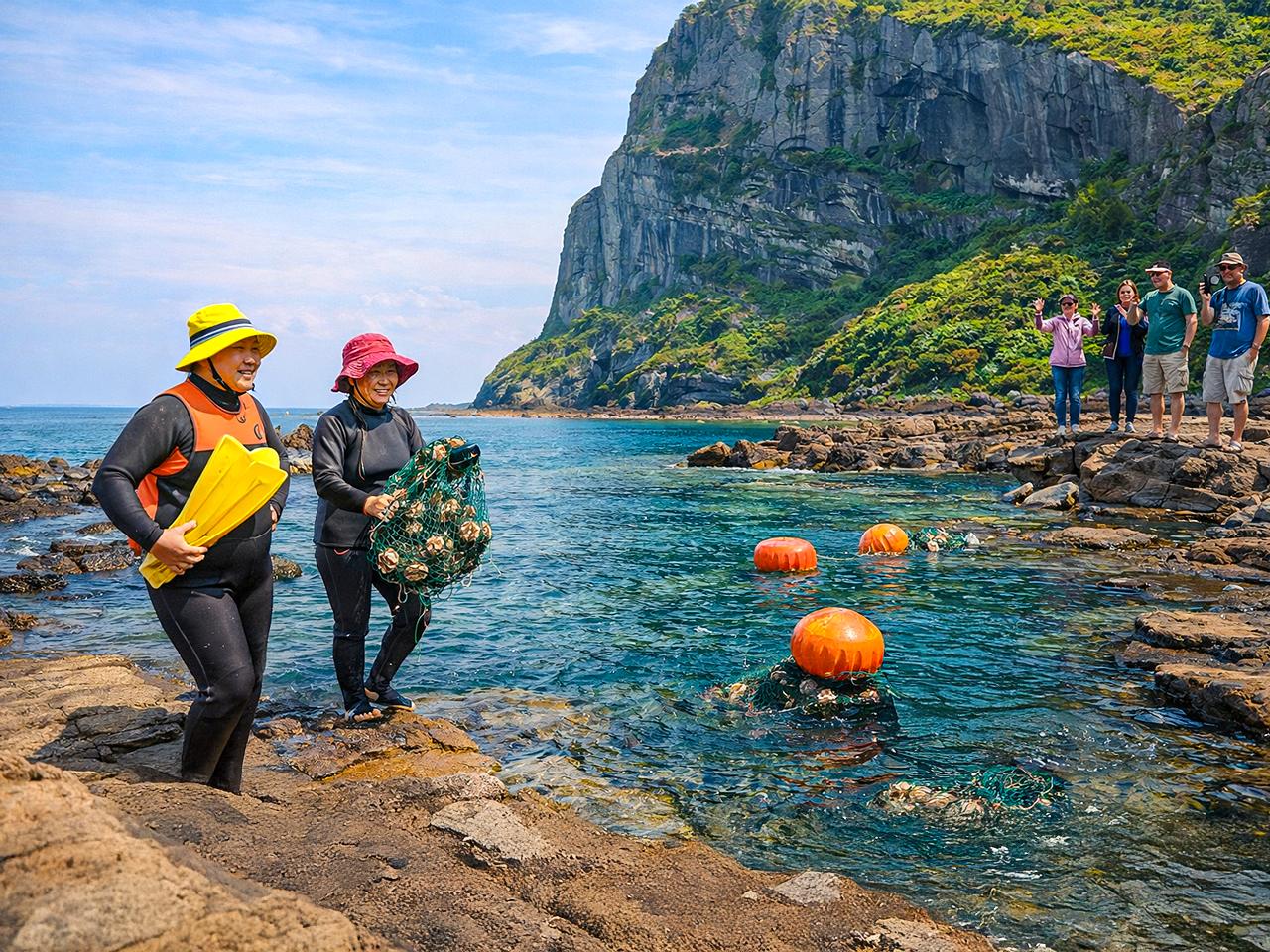
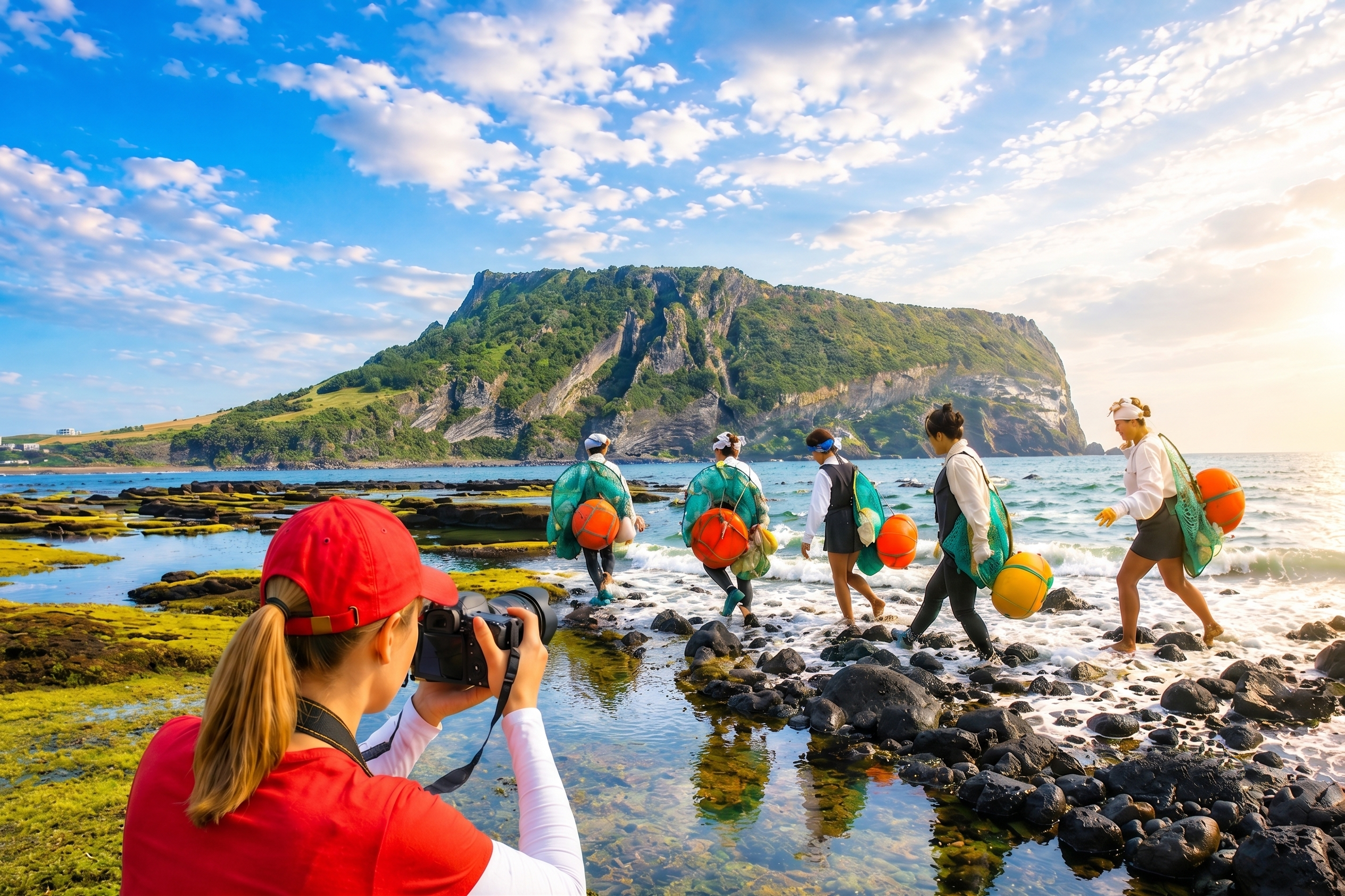
Seongsan Ilchulbong rose from the seabed 5,000 years ago in a single hydrovolcanic eruption, its symmetrical tuff cone freezing ash and steam into a fortress that now defines Jeju's eastern skyline. The crater measures 600 metres in diameter, its rim crowned with 99 stone pinnacles that locals call seongsan — castle mountain — and the UNESCO World Heritage Committee inscribed it in 2007 as an exemplar of Surtseyan volcanism, the explosive interaction of magma and shallow water that builds steep-walled islands in days. Today a jeju east tour from seogwipo anchors half-day itineraries that knit together three Jeju Volcanic Island and Lava Tubes components: Seongsan Ilchulbong, the nearby Seongeup Folk Village with its thatched black-basalt houses, and the lava shoreline where haenyeo freedivers harvest sea urchin and abalone without breathing apparatus. The eastern arc represents Jeju's younger volcanic phase — shield volcanoes and parasitic cones built during the last 300,000 years — and the geology remains legible: oxidised scoria layers band the cliff face in rust and ochre, and the interior bowl preserves a meadow grazed by horses descended from Mongolian stock introduced in the thirteenth century. The 500-step ascent to the crater rim begins at 284-12 Ilchul-ro, where a stone staircase with regular platforms climbs the seaward flank through wind-pruned grass and dwarf bamboo. The trail was paved in 2003 to manage erosion from 1.8 million annual visitors, and the engineering succeeded: the path is stable in all weather, the grade consistent, and the handrails unobtrusive. At the summit the crater opens suddenly — a near-circular amphitheatre 90 metres deep, its walls scalloped by rainwater gullies and its floor quilted in green. Jeju east tour from seogwipo routes typically allocate 90 minutes at Seongsan Ilchulbong: 40 minutes for the ascent and rim walk, 20 minutes at the viewpoint, and 30 minutes for descent and the lower coastal path. The conservation fee is 5,000 won per adult, collected at the trailhead, and the site opens at 05:00 to serve sunrise hikers who time their arrival to the 05:52 July dawn. Most guided tours depart Seogwipo between 08:00 and 09:00, reaching Seongsan by 09:30 when the eastern light still rakes the crater's interior and the tour-bus crowds have not yet filled the summit platform.
"The crater measures 600 metres in diameter, its rim crowned with 99 stone pinnacles that locals call seongsan — castle mountain."
A step-by-step walkthrough of the visit — what you'll see, how long each stage takes, and the details that matter.
You leave Seogwipo in the blue hour before full sunrise, the coach tracing Route 97 along the southern shore past tangerine orchards and stone-wall paddocks until the road bends north and Seongsan Ilchulbong appears — a dark cone against the brightening east. The bus parks at the visitor plaza at 284-12 Ilchul-ro, and you cross the footbridge over tidal flats where women in black wetsuits are already working the shallows, their tewak floats bobbing in the current. The trail begins as a wide stone staircase, each step faced with local basalt, and you climb steadily through switchbacks that reveal more of the coast with every turn: Udo Island offshore, the Seopjikoji headland to the south, fishing boats radiating from Seongsan Harbour. At the 300-step mark the grade eases and the handrail ends; the final approach is a dirt track across the crater's outer slope, and then the rim opens in front of you — a sudden 90-metre drop into a green bowl ringed by serrated walls. You walk clockwise along the rim path, the wind constant and cool, and pause at the stone marker that notes the 182-metre summit elevation. Below, horses graze the crater floor; beyond, the ocean stretches unbroken to the horizon. After 20 minutes you descend the western stairs, your knees absorbing the long step-down, and emerge at the coastal path where haenyeo demonstrations begin at 13:00 in summer months.
Seongsan Ilchulbong is open daily from 05:00 to 19:00.
The entrance fee is 5,000 KRW (conservation fee, per adult visitor).
There are 500 steps to reach the summit of Seongsan Ilchulbong.
The best arrival window is 05:00–09:00 to avoid mid-day heat and large crowds.
The summit trail is not accessible for wheelchairs, but a flat coastal trail is available.
Pets are not permitted at Seongsan Ilchulbong.
No, food and drinks are prohibited on the summit path at Seongsan Ilchulbong.
You can reach the site via bus (111, 112, 211, 212) or by car/taxi from Seogwipo.
Yes, Seongsan Ilchulbong closes on the first Monday of every month.
No, drones are strictly prohibited during your jeju east tour from seogwipo.